
Ted Reshetiloff tours the relaunched H48 in Annapolis with Hylas sales director Kevin Wensley — from the Ultra anchor on the bow to the fuel-polishing manifold under the galley sole.
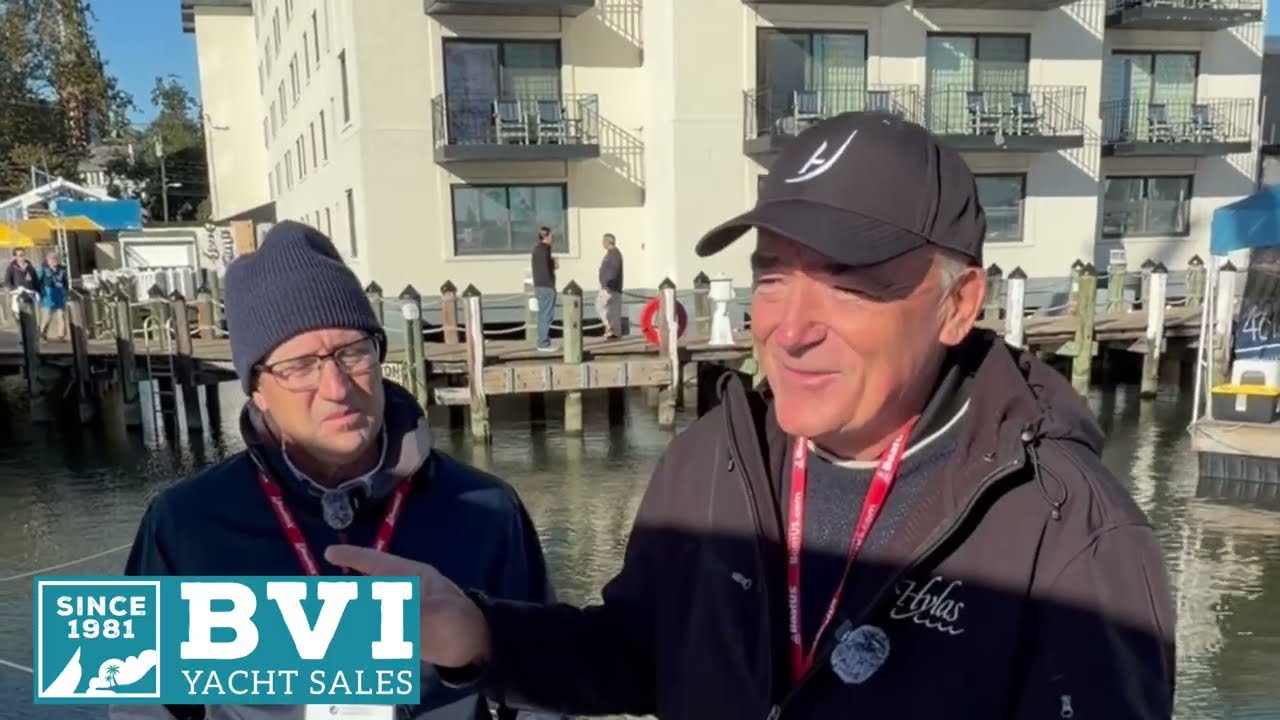
Annapolis, last day of the boat show, and Ted Reshetiloff is standing on the side deck of a yacht that hasn’t shown its face in Maryland for about five years. The boat is S/V Hull 5, the fifth hull of the Hylas H48, and the man giving the tour is Kevin Wensley, sales director for Hylas Yachts. What follows is less a sales pitch than a conversation between two people who know boats — and it covers a lot of ground, from anchor lockers to the way a hull is built from the inside out.
Wensley sets the scene early: the 48 launched roughly six years ago, then Hylas “got really caught up building other models.” This is a relaunch. When the model first appeared it was named Boat of the Year by both Cruising World and Sail magazine, with the judges singling out fit and finish, the in-house stainless work, and the teak decks — about a quarter-inch of it, laid throughout.
The center cockpit argument
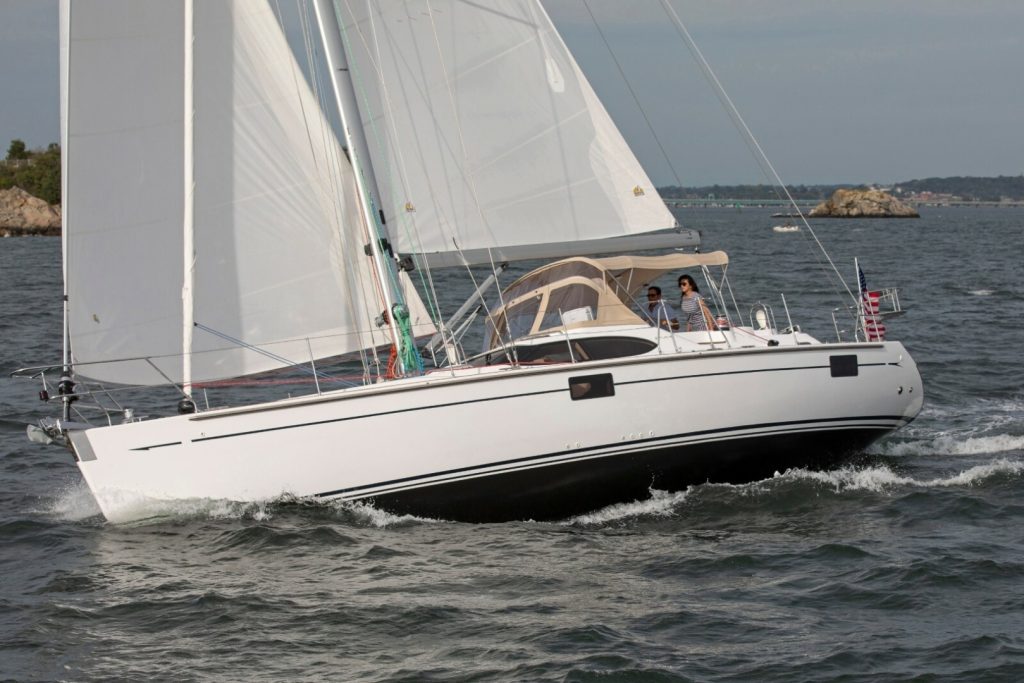
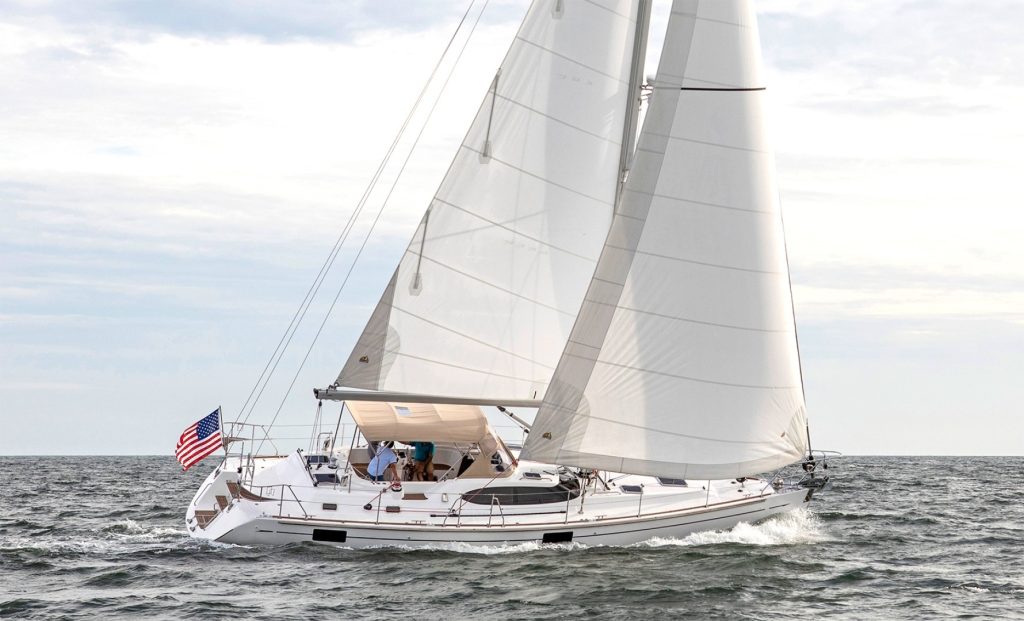
This is a classic Hylas configuration: center cockpit, cutter rig, blue-water capable and, as Wensley puts it, easy enough to short-hand that a couple could take her around the world. He gives the usual safety case for a center cockpit — you’re removed from the water, and a following sea isn’t going to fill the footwell — but he’s more interested in what the arrangement buys you below decks.
“What I like about this is what it does for us down below,” he says. Three things follow from it: a walk-through galley, extraordinary access to the engine compartment, and an aft master stateroom that “really should belong on a much bigger yacht.” We’ll get to all three.
On deck: smart winches and serious stainless
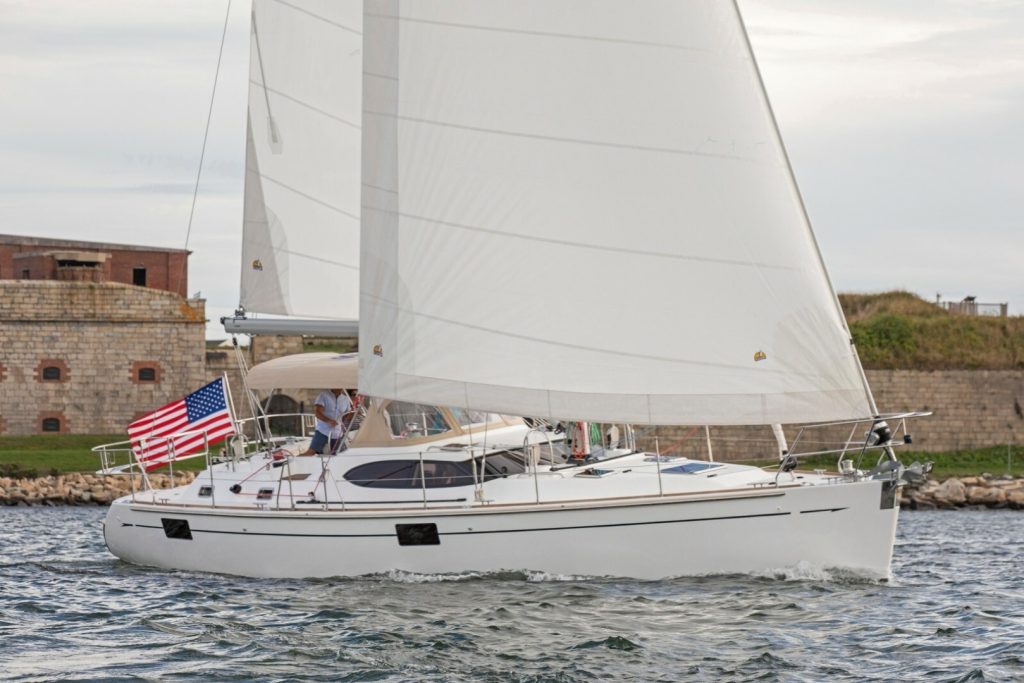
All the winches are powered — no surprise in this class — but one of them is what Wensley calls “a very sexy winch”: a Selén smart winch that talks directly to the in-mast furling motor. Load the outhaul onto the drum, press a button, and the two devices negotiate between themselves how much load is needed and when to stop. Press another button to put the main away again.
He’s candid about the in-mast-versus-in-boom debate that occupies every boat show dock, and he comes down firmly on in-mast for reliability and usability. The horror stories about jams, he argues, belong to twenty years ago; the sails come from North and the spar from Selén, and both now design specifically for the job.
Forward, the bow gets proper attention. The platform is 316L stainless so that chain movement doesn’t chew up the yacht, and there are fresh- and saltwater washdowns inside the locker. Two anchor rollers feed two separate chain lockers — one per rode — for those rare occasions you need a second hook down. Standard kit includes 300 feet of galvanized chain and an Ultra anchor, which Wensley cheerfully describes as “boat bling.” Behind all of it sits a watertight collision bulkhead forward, with a second one aft; Hylas has built them in as standard for a long time.
At the mast, the halyards are notably tidy. Because the genoa, staysail and main all furl, they go up and stay up — so the tails get locked into mast tracks, disconnected and stowed elsewhere. “There’s not lots of spaghetti here at the mast,” Wensley notes. Running backstays support the rig when the staysail is loaded up, and he takes a moment to explain to the camera exactly why they exist, which is the sort of thing that tells you how the company talks to its owners.
Support that comes with the boat
That training instinct is formalized. Every new Hylas owner gets a week with a Hylas skipper trained in coaching, so that when they leave the dock they actually understand the systems they own. Beyond that, Hylas — a third-generation, family-run builder — says it expects to support a yacht for the life of the yacht, first owner or fifth. Service and program director Christian, who has been with the company 24 years, joins the conversation and recounts talking a third-generation owner through a broken shroud in the middle of the South Atlantic: they rigged a pole out to one side with a halyard led down to it, got the mast supported, and sailed the last 400 or 500 miles to shore. “Usually it’s more about plumbing and, you know, fuses,” he adds.
Below: light, weight, and where things live
Ted’s first reaction coming down the companionway is the light. Bill Dixon’s design brief, Wensley explains, was that descending into the saloon shouldn’t feel like entering a cave — hull windows and oversized port lights let you see out whether standing or seated. But raising the saloon sole has a second payoff: fuel tanks, water tanks and batteries all live beneath it, low and centered over the keel.
The galley is the walk-through type, which braces you naturally underway. Cooking is LPG — convenient, readily available, and no heavy draw on the batteries offshore. Fridge and freezer open from both the top and the side. The sole panels are positive-locking so they stay put when the boat gets lively. And underneath sits a fuel manifold serving three tanks (plus generator fuel), with valves that let you run fuel through the polishing filters and back to a tank independently of the engine. It looks complicated; Wensley’s answer is that they train you on it.
Aft, the master stateroom is the showpiece — roughly 13 feet of beam carried well aft, a big double berth with access from both sides, abundant natural light and pre-wiring for a television. Engine access, meanwhile, runs all the way around: front access on both sides, plus a panel in the master head.
The materials deserve a note. This boat is finished in white oak rather than the dark teak interiors Hylas was traditionally known for, with solid teak on the sole — 3/16 of an inch thick, not a paper veneer. As Ted points out, that’s enough real wood that someone refitting the boat in 25 years will still have something to work with.
What it costs
Wensley is straightforward on price. Base for the H48 is around $1.57–$1.6 million. Hull 5 is specced at roughly $1.7 million, reflecting about $100,000 of upgrades: pre-wired davit bases (the davits themselves still to come), pre-wired and pre-plumbed watermaker, and upgraded fabrics. Delivery and duty/tariffs are included in that figure. A buyer would still want to add a bimini and dodger — absent here only because the boat is so new that Christian hasn’t had time to make them yet — plus the watermaker unit itself. There’s also provision for a washing machine in the aft head.
| Base price (approx.) | $1,570,000 | |||
| Hull 5 as specced | $1,700,000 |
Start from scratch and you’re looking at roughly an 18-month build, with choice of woods, fabrics, colors, and cabin reconfiguration within reason — as long as structural bulkheads stay put. Hylas builds from the inside out: hull first, then carpenters, shipwrights and electricians fitting the interior to that specific molding. The payoff, Wensley argues, is a quiet boat when it’s noisy on deck — no squeaks, no bangs from an interior module hoped into place.
Market snapshot
| Active Hylas 48 listings | 2 |
|---|---|
| Asking range | $1,730,000 – $1,730,000 |
| Median asking | $1,730,000 |
Wensley’s parting observation on the used market is worth repeating for anyone shopping older hulls: a neglected Hylas is still a robust, solidly built yacht that can be brought back without extravagant spending — and when one does surface, it tends to move quickly.