
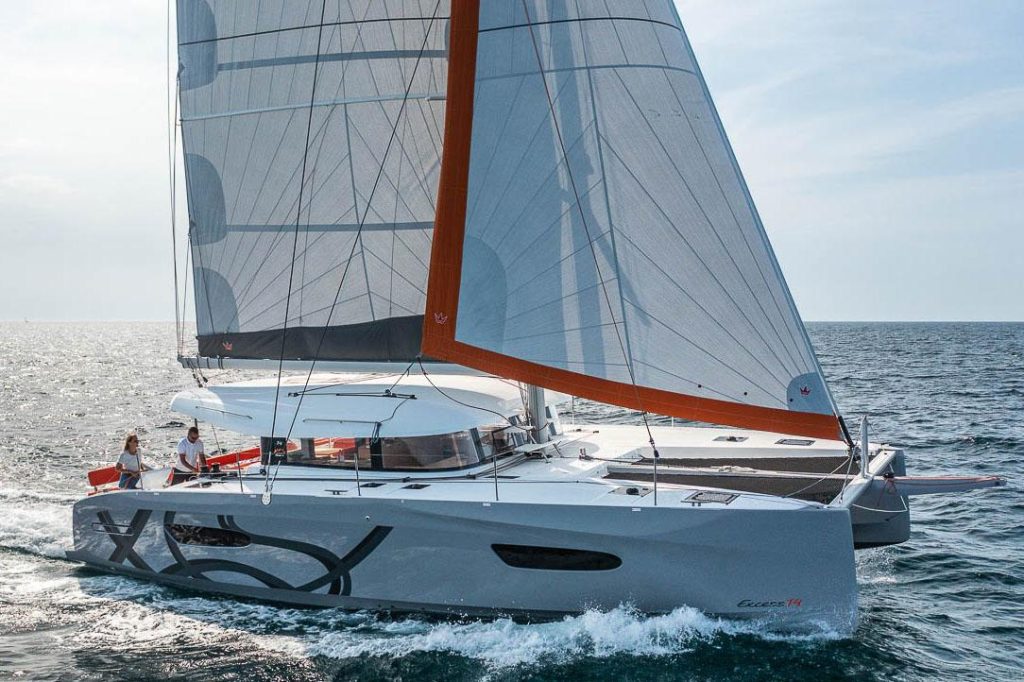
A 2024 Excess 14 Pulse Line with a hydrogenerator, 2 kW of solar, four en suite cabins — and an engineer-owner who documented every modification in a booklet left at the nav station.
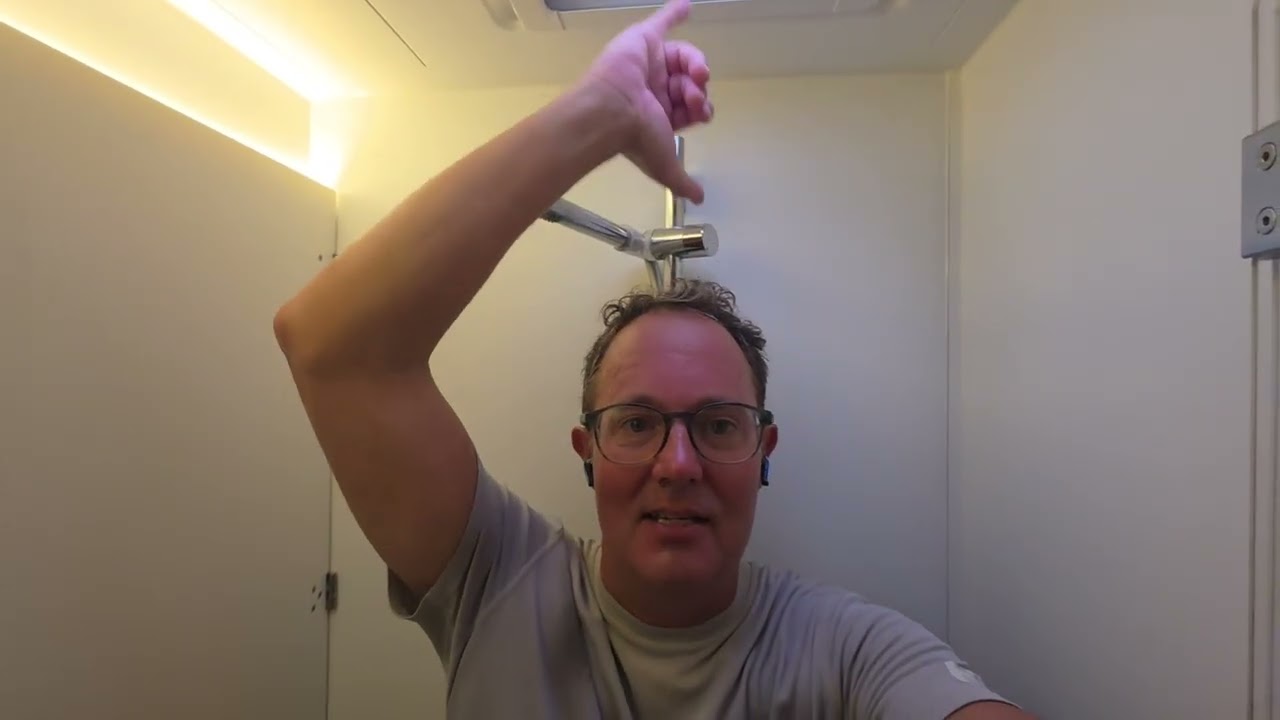
Some brokerage walkthroughs are a quick sweep through the cabins. This one is closer to a handover briefing. The owner of S/V Mulan, a 2024 Excess 14 Pulse Line listed by Chris Rundlett, spends the tour explaining not just what is aboard but why it is there — and in several cases, what he changed and the reasoning behind it.
The performance version, and it shows
Mulan is the Pulse Line iteration of the Excess 14: longer bowsprit, taller mast, larger mainsail and genoa, plus a code zero and a parasailor. The owner is direct about the result — “she’s meant to be fast” — and points out the asymmetrical hulls with keels angled slightly outboard and hydrodynamically shaped rather than flat. His own verdict after extensive miles: she points surprisingly well and is “really not slow on the water.”
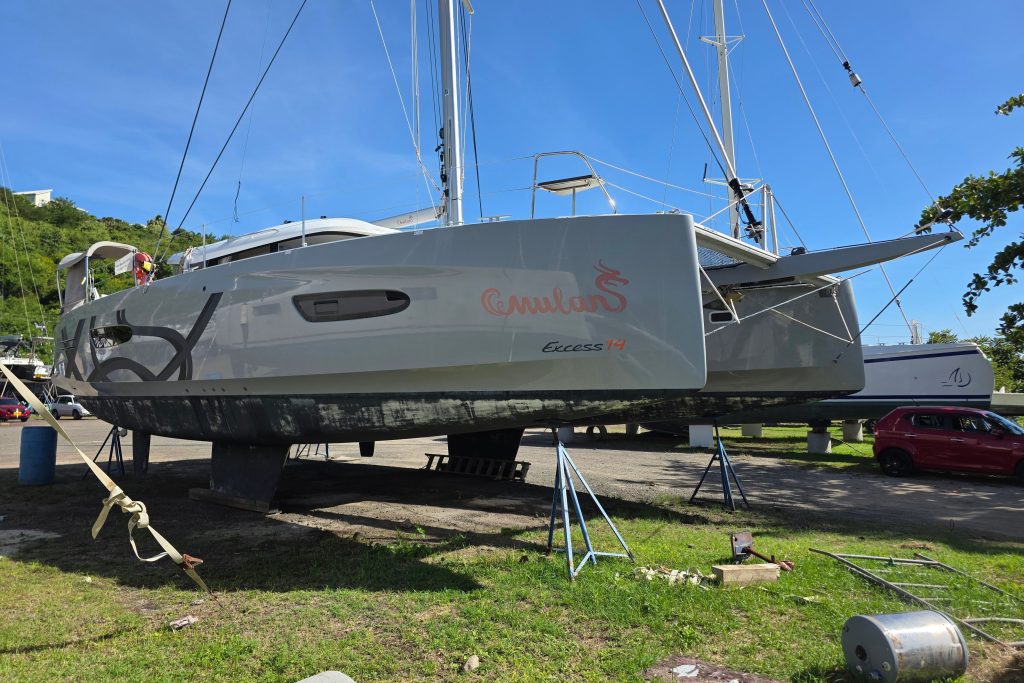
The video opens with the boat out of the water, and the owner explains there is no antifouling on at the moment for two reasons: so a surveyor can inspect the hull in detail (“I’ve got nothing to hide here”), and because antifouling loses efficiency if applied long before launch. The folding three-blade props have been polished with brand-new zincs on both sides.
Energy: sail forever without the genset
The systems story is the strongest thread in this tour. A Watt & Sea POD 600 hydrogenerator produces up to 600 watts, and the owner says that above roughly 8.5 knots at night it covers the boat’s draw outright — “we’re not draining battery anymore… we can sail forever without having to start the generator ever. Which we usually didn’t.” Backing that up are 2,000 watts of solar (400 W forward, 1,600 W aft) with space remaining for more, a 2,000 W inverter, and a Fischer Panda 10 kW generator.
Three Webasto air conditioning units — 16,000 BTU each, one per hull and one in the saloon — are fitted, along with a Webasto water heater tucked beneath a berth. Fresh water comes from two 300-litre tanks (600 litres total) plus a watermaker rated at 105 litres per hour. A saltwater foot pump at the galley sinks stretches that further. Galley equipment includes a dishwasher (“frankly, we almost never used it”), an electric stove with a plancha add-on, and a brand-new cockpit fridge-freezer unit replacing an original that never worked properly, supplemented by a low-draw mobile fridge the owner bought while cruising.
The electrical cabinets get their own close-up, and they deserve it: VHF, Starlink, C-map tracking that sends position and sensor status via GSM so the boat can be monitored from anywhere, 12 V fuses and the shore-power/generator switching, all labelled and accessible. Engine servicing has been done every 250 hours rather than annually — on a boat not yet two years old, that is more maintenance than required.
Living aboard
The cockpit seats ten-plus, with an extendable table and a bench that slides out. Both saloon and cockpit tables drop — one on gas struts, the other via spare legs stored in a locker beneath the bench — and with cushions in place they convert into a large sleeping or lounging area. Mounting points for video screens are scattered around, allowing several configurations depending on whether you are watching a film as a couple or as a family. Five small gas bottles live under the cockpit bench, and a ten-person grab bag, flares, fire extinguisher, first aid kit and water spares are stowed within easy reach.
Below, this is a four-cabin, four en suite layout. The owner’s port aft cabin measures 1.6 m across at the shoulders, with hatches on both sides and overhead for cross ventilation, plus its own three-screen home cinema setup with an Anker projector. The heads are notably generous — at about 1.80 m tall, the owner has headroom to spare in the showers, and two of them include wet lockers. Forward cabins have served as kids’ cabins; the port one opens into a bow crawl space that his children treated as a cave. A full-size 9 kg washer-dryer is fitted to starboard, usable on shore power or with the generator running.
On deck and single-handed
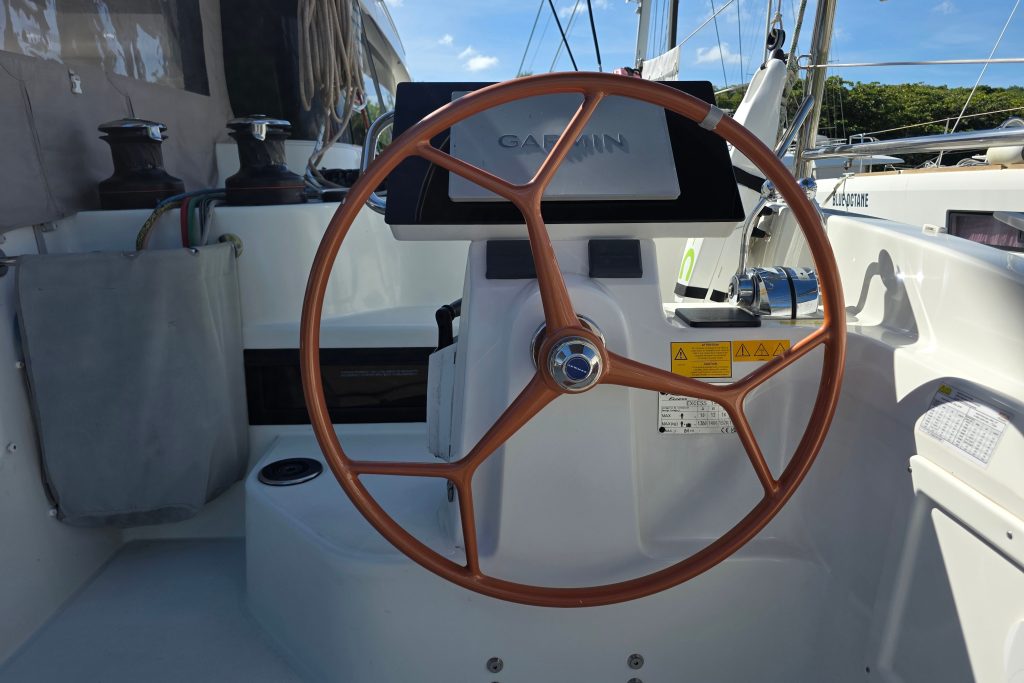
The helm station is set up for solo sailing, something the owner has done for days at a time. Genoa sheets, main sheet, three reefing lines, main halyard, topping lift, genoa halyard and furler all terminate within reach, served by one two-speed electric winch and a manual one — the electric reserved mainly for hoisting the main or lifting the dinghy. A second helm station on the opposite side carries a slightly smaller chart plotter and the winch for code zero and parasailor sheets, plus the emergency tiller. The owner particularly values the low boom, which makes reefing and sail work manageable offshore.
Ground tackle is an oversized Spade with 100 m of 10 mm chain and a freshwater washdown, with spare Delta and Danforth anchors in the sail locker alongside the parasailor, code zero, spare lines and halyards. A sky lounge with sunbathing pads and two fold-up seats sits above the saloon, though the owner admits the family preferred clip-on benches at the trampoline for the breeze. Safety is thorough: roughly eight fire extinguishers including two automatic units in the engine rooms, and compliance with ocean race safety rules. The boat is CE Category A certified for ten people.
Every modification the owner — a power plant engineer by trade — made is written up in a booklet kept at the nav station and available electronically, and he offers to stay reachable by WhatsApp for a new owner.
Market context
The Excess 14 is a thin, young market. Here is what the data currently shows:
| Metric | Figure |
|---|---|
| Excess 14 sold, last 24 months | 1 |
| Median time to sell | ~131 days |
| Active Excess 14 listings | 2 |
| Asking range | $569,000 – $598,000 |
| Median asking | $583,500 |
| Low asking | $569,000 | |||
| Median asking | $583,500 | |||
| High asking | $598,000 |
With only a handful of boats changing hands, a well-documented, heavily optimised Pulse Line with a circumnavigation’s worth of spares aboard stands out on its own merits rather than on price comparison alone.