
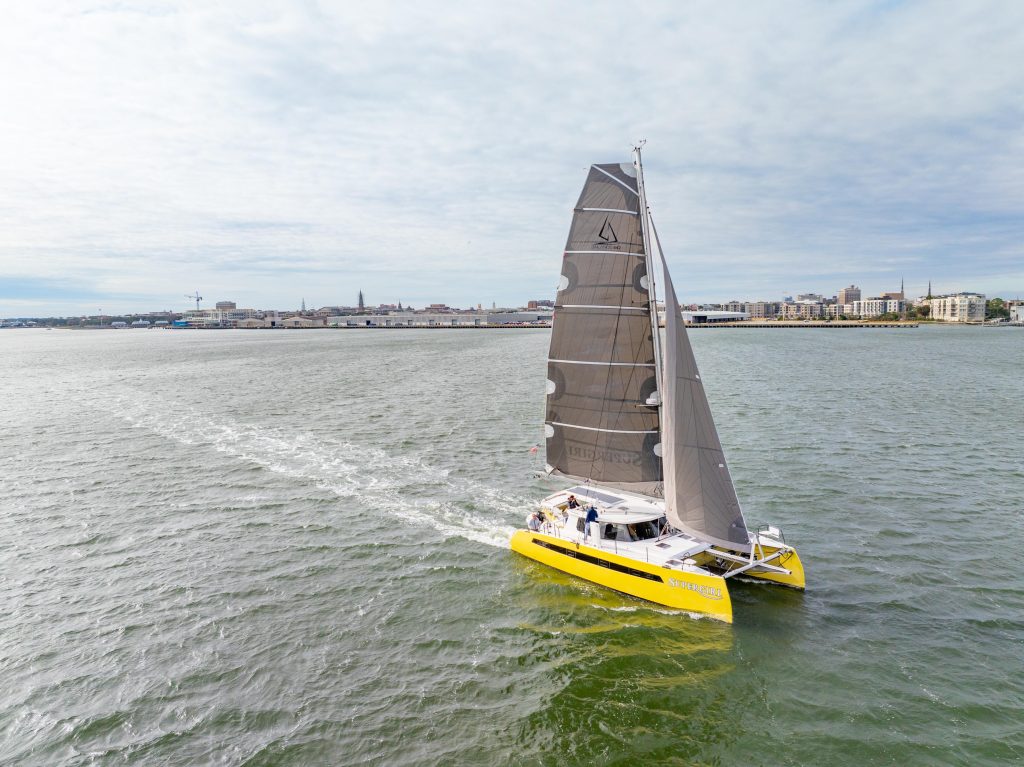
Balance's former technical director tours a 2022 owner-version 442 and explains why every detail — from the VersaHelm to the anchor hatch — was put where it is.

There’s a particular pleasure in being shown a boat by someone who helped draw it. In this walkthrough, broker Andrew Hodgdon — the former technical director for Balance — tours S/V Supergirl, a 2022 Balance 442, and spends far less time selling than explaining. Why the steps alternate. Why the anchor lives behind a trapdoor. Why the salon glass is glass. It’s the kind of tour that rewards a buyer who has already narrowed the field to performance cruising catamarans and now wants to know how one actually lives.
The cockpit: lounging, cooking, and the VersaHelm
The tour opens in the cockpit, where Hodgdon points out the sheer volume of lounge seating and the cockpit table that drops down with a fill-in cushion to create one large lounge bed — usable in combination with the sun lounge forward. Storage hides under the seating, under the aft seating and around the table, and the helm seat conceals a large refrigerated compartment that can serve as a drinks fridge or, before an offshore leg, get packed solid with perishables.
The signature feature is the VersaHelm. The helm station swings down into a protected inside position with a seat, full 360-degree visibility through the salon windows and genuine weather protection, with throttles within comfortable reach for motoring or motorsailing. Swing it back up and it locks, the top slides open, and you’re steering in the sunshine and breeze. Instruments and a chart plotter are duplicated at both positions, and throttle access is available from either.
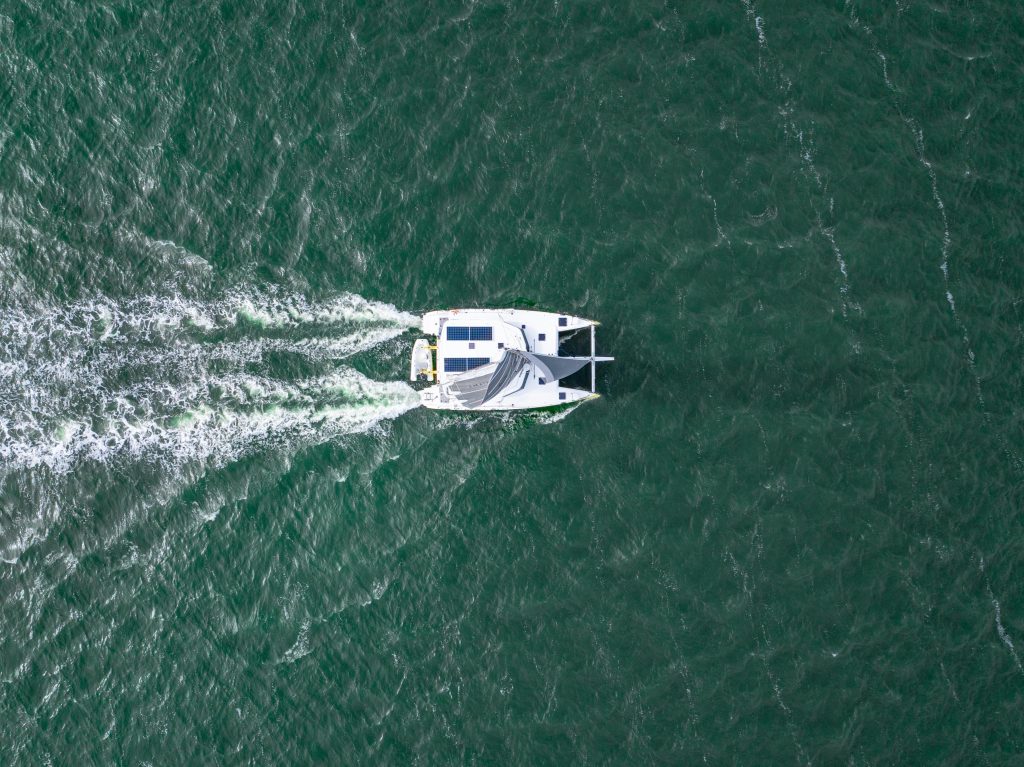
Elsewhere in the cockpit: a Kenyon electric grill with a small sink and tap, and carbon fiber davits designed for high loads, currently carrying a center console dinghy with a 20-horsepower outboard — which Hodgdon calls about the right size for this boat. Aft, the scoops have wide boarding platforms with an exposed corner, so stepping aboard from a dock doesn’t mean climbing over a gunwale, and the oversized swim ladder collapses and can be removed at sea. Engine access, he notes, is genuinely good: a large hatch puts strainers, fuel filters and the engines right in front of you rather than requiring you to hang upside down in a bilge.
On deck: dagger boards, handholds and smart ground tackle
Moving forward, the dagger board controls are manual up-and-down lines that can usually be worked by hand when unloaded, with an electric winch nearby for mechanical assist when they’re loaded up. Line storage bins are built into the steps. Three electric winches and the clutches sit at the upper helm, with all lines led from the mast, so the boat can effectively be run from that one position.
Hodgdon lingers on details that only reveal themselves in use: handholds molded into the hardtop with a proper lip to grip — and which can double as rain catchment if the boat is set up for it; laminated glass salon windows rather than polycarbonate, so they never craze into that spiderwebbed look and can be treated with rain repellent; dolphin seats oriented forward with a backrest, which he argues is what people actually want, rather than the aft-facing arrangement common on other catamarans. The stanchions are taller than typical factory items, anodized aluminum, and attached to fixed deck points so they don’t crack like bolt-on extensions.
The ground tackle arrangement is a small masterclass. The anchor is reached through a trapdoor in the locker, which shifts its weight aft off the crossbeam while keeping access easy; the bridle clips to a D-ring so it can’t be lost and goes out with the chain. The windlass sits in its own accessible, wet-rated locker with plenty of chain drop to avoid pile-up jams, and its breaker is right there rather than buried inside the boat.
Supergirl carries a self-tacking jib on a furler — main-and-jib sailing about as simple as it gets — with proprietary sails in a grey material chosen for performance and longevity. Up top there’s 1,600 watts of solar and Starlink.
Inside: galley, salon and systems
Three sliding doors open the salon to the cockpit for a true indoor-outdoor feel. The joinery on this particular boat is American oak — real wood veneer over foam core for weight savings, handcrafted, and semi-custom like all Balance interiors. The galley has a custom farm sink that accepts drain racks and cutting boards, a built-in draining dish rack, a four-burner Smeg induction cooktop, a Whirlpool convection oven that doubles as a microwave, a built-in spice rack and dark grey Corian countertops. Refrigeration comes from two Vitrifrigo double-drawer units that can each be set as fridge or freezer in any combination.
A forward-facing nav station holds the integrated control screen, Victron battery monitor, VHF and 12-volt switching; Hodgdon notes that the vast majority of the boat’s electronics run at 48 volts. The U-shaped settee is large enough to sleep across and has a custom trifold table — fiddled and grippy for offshore, opened flat for dining at anchor — that also drops to form a queen-sized lounge bed. Tinted laminated glass and custom Ocean Air blinds handle UV and privacy.
Accommodation
The alternating tread steps take a moment to get used to but allow a comfortable stairway without a landing interrupting the hallway. Down to port, the corridor is lined with cabinetry and drawers, with the dagger board trunk, two inverter/chargers, the watermaker and the electrical panels along the way. A large privacy door closes off the entire owner’s suite, with a washer/dryer behind it. The master has a queen berth, hanging lockers, under-bed storage, cubbies and outlets both sides, plus a clever port light opening into the deck locker — leave the deck hatch open and you get secure ventilation that keeps rain out, like an old dorade. The bow locker on that side is fitted out as a walk-in closet, though it could equally become a workshop or gear store.
The owner’s head is a highlight: an oversized shower with headroom to spare for a six-foot-one presenter, a seat, a Tecma electric toilet switchable between fresh and salt water, and a big vanity. Behind a nearby cabinet, the steering system and winch solenoids are reachable in seconds — a theme Hodgdon returns to throughout.
To starboard, the guest head is centrally located inboard with a separate shower stall in one unit, a layout he says differs from larger boats in the Balance range. The forward guest cabin closely mirrors the master minus the closet (the sail locker takes that space, accessed mainly from deck), while the aft guest cabin has a slightly smaller berth, good storage including a large space under the bunk, and plenty of light and ventilation from the port lights.
Where the 442 sits
The three-cabin owner’s version, as Hodgdon frames it, suits a cruising couple or small family intent on real blue-water voyaging without giving up liveaboard comfort. For context, five Balance 442s have sold on the site in the last 24 months at a median of $1,150,000, taking a median of roughly 203 days, with three currently active.
| Balance 442 | Figure |
|---|---|
| Sold, last 24 months | 5 |
| Median sold price | $1,150,000 |
| Median days to sell | ~203 |
| Active listings | 3 |
| Asking range | $1,099,000 – $1,399,000 |
Hodgdon closes by offering to arrange a showing directly. For a buyer weighing the 442 against other performance cats, this video is worth the watch simply for the reasoning behind the details.