
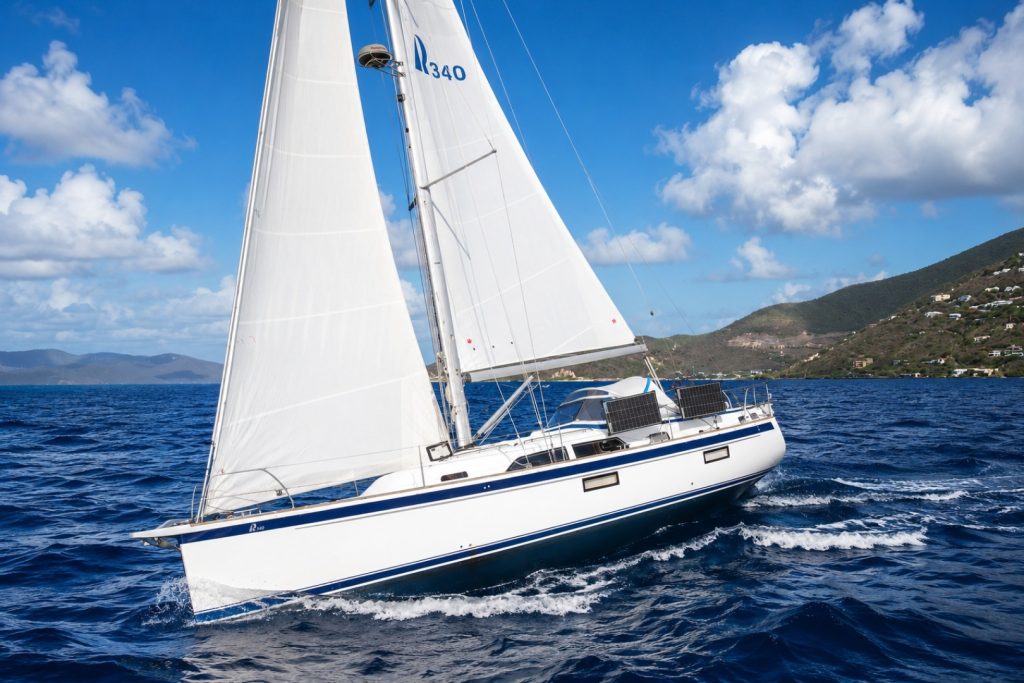
Every box on the factory order form ticked — and then some — on a 2025 cruiser specced from the outset to qualify for the ARC.
Anchored in Little Harbour off Peter Island — one of the prettiest corners of the BVI, and, as broker Ted Reshetiloff puts it, one of his favourite spots anywhere — S/V Umami makes an easy first impression. The turquoise water helps. But the real story of this 2025 Hallberg-Rassy 340 is what was ordered, added and refined after she left the factory.
“Every box that was on the order form was ticked,” Reshetiloff says, and the cockpit is where that starts to show.
Twin wheels, double redundancy
The base 340 ships with a tiller. Umami came with twin helms instead, each fitted with its own Axiom chart plotter for redundancy, plus wheel locks. The port pedestal carries lighting control for running and navigation lights, bilge pumps and a wash-down pump, with the electric headsail furler control below — unfurling and furling the genoa becomes a one-finger job. There’s also a backup autopilot control here; the owner’s preferred unit is mounted forward under the dodger, leaving this one as the spare.
To starboard sits the second Axiom, the Volvo Penta engine controls, an electric windlass control with chain counter, and the Side-Power bow thruster. That thruster is a 6 hp unit — unusually muscular for a 34-footer. The owner recounts being pinned sideways on a dock in upwards of 30 knots, with marina hands insisting he’d need a tow off. He didn’t.
Specced against the ARC
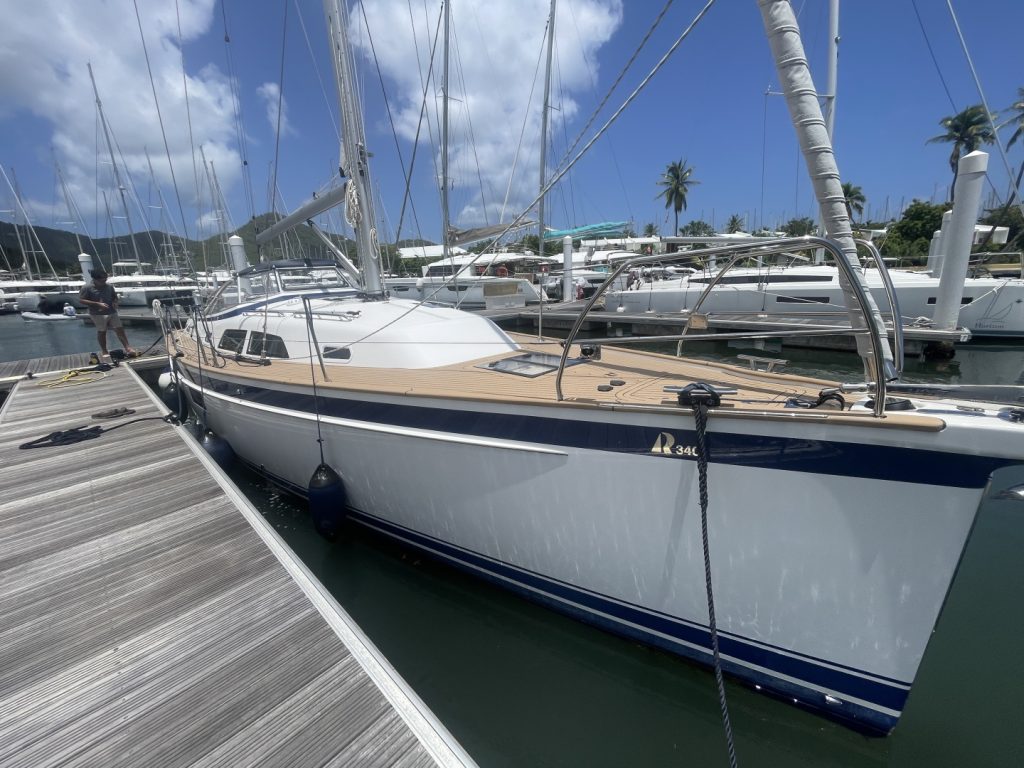
The point Reshetiloff keeps returning to is that this boat was specced from the start against ARC requirements. The rally demands a manual bilge pump operable from the cockpit — hence the Whale pump visible aft, part of a three-pump bilge setup that is, by his own admission, “not normal on any boat.” Add the electric emergency bilge pump, the watermaker, the enlarged lithium bank and a solar regulator wired for additional panels, and the compliance scramble that catches out many crews on the dock in Las Palmas simply doesn’t apply here. As he sums it up: “You’re ready to rock and roll.”
She’s also genuinely US-spec, which matters more than it sounds. Hallberg-Rassy will fit 120-volt systems but won’t supply propane; this boat had propane added, with brackets fabricated to hold US-diameter bottles. The electrical system is US-spec too, so a 30-amp shore cord at an American dock is no drama. The boat has been fully imported into the United States, so there’s no import duty outstanding.
Power, water and the no-generator argument
The electrical system has been thoroughly revamped since delivery. Two additional 220 amp-hour batteries sit forward, wired in parallel and mounted side by side so there’s no current drift between them. Charging comes from an Arco 200-amp alternator — the owner reports seeing around 180 amps in practice. The payoff: pull into an anchorage at 80 percent, run the air conditioning overnight with the boat closed up, and be back to roughly 70 percent after about two hours of engine time the next morning.
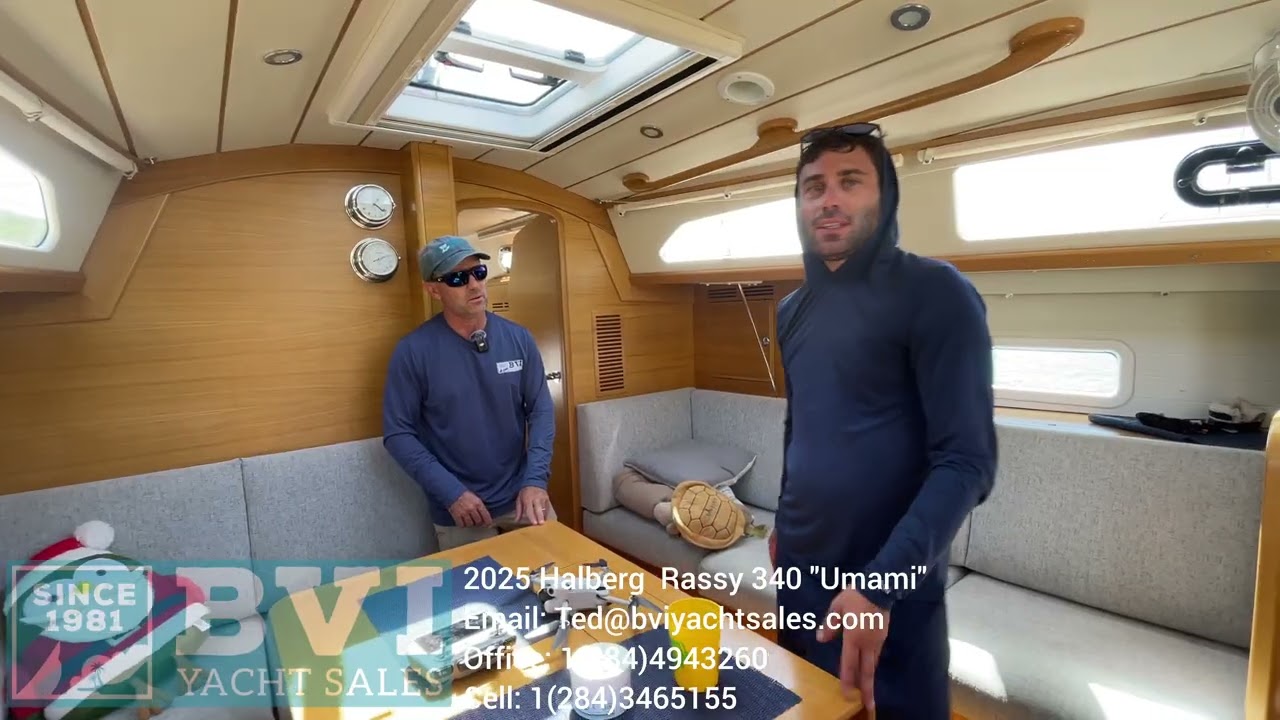
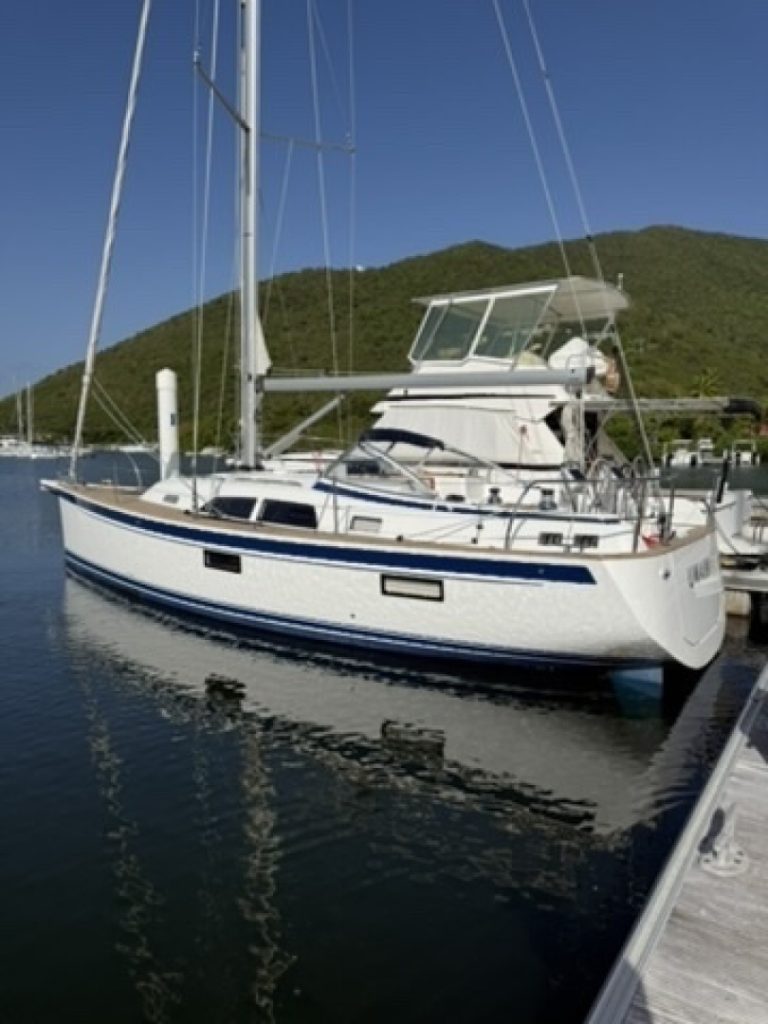
That setup deliberately replaces a generator and avoids a stern arch. As the pair discuss on camera, a 34-footer simply doesn’t have the real estate for a big solar array, and bolting an arch onto the transom would add windage aft and upset the balance against the headsail. No arch, no “little Honda noise box” with jerry cans — simpler, quieter.
A Spectra watermaker is the most recent addition, producing 8 to 10 gallons per hour, with a tank-to-sample knob that discharges into the galley sink and a water meter for testing before you commit a batch to the tanks. The installation quality — the control panel cutout in particular — gets singled out for praise. The one honest caveat offered on camera: the seacock and strainer live under the floor, so you’ll be lifting a sole panel to reach them.
Owner’s attention to detail
Smaller touches tell you plenty. Ocean Air hatch blinds with integrated screens throughout. Hatch lines run both sides so you can rig from either side at a dock or on a mooring. A wash-down fitting aft that doubles as the swim shower. And on the engine, a dedicated hose plumbed to the sump so oil comes out from the lowest point rather than via the dipstick — changed religiously every 100 hours. The Volvo Penta has always had factory service, the saildrive has been professionally serviced, and the boat has been under professional management since new.
Where she sits in the market
Hallberg-Rassy listings are thin on the ground, which is normal for the brand.
| Active Hallberg Rassy listings | 2 |
|---|---|
| Asking range | $429,000 – $534,000 |
| Median asking | $481,500 |
| Inquiries, last 30 days | 1 (vs 0 prior 30) |