
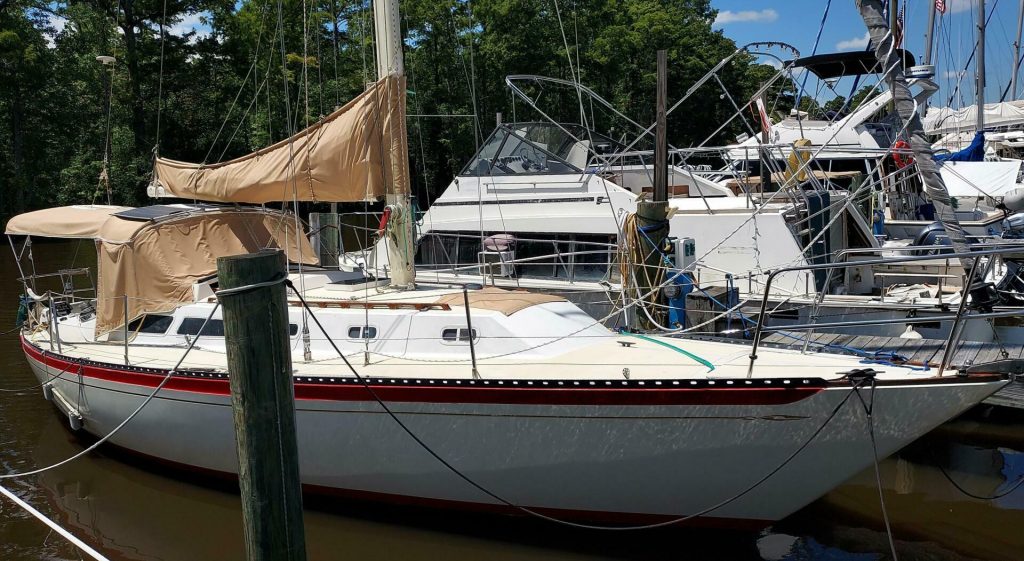
New sails, new canvas and a thick stack of records make this North Carolina club racer an easy boat to take sailing.

Lars Bergstrom of Curtis Stokes walks us through S/V Windancer, a 1977 Islander 36 lying near Plymouth, North Carolina. It’s a familiar shape to anyone who has raced on a Thursday night — roughly 800 of these Islander 36 models were built, and they remain a staple of local club regattas. As Bergstrom notes, she sails well to her handicap, particularly with the newer sails and rigging this boat carries.
On deck
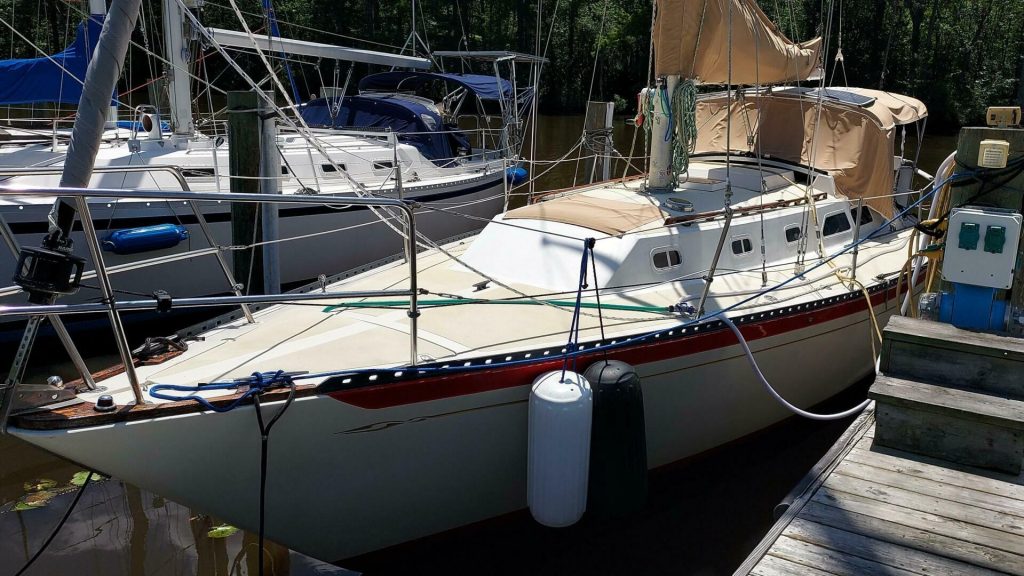
The tour starts forward, where a bronze spool sits on the anchor roller and a deck locker swallows the anchor and chain — keeping that weight and mess out of the accommodation. Headsail furling is handled by a Harken Cruising unit, a relatively new design that Bergstrom describes as practically indestructible. Gel coat and paint look good, the varnish has been done recently, and canvas covers protect the hatch.
One of the Islander 36’s defining traits shows up here: chain plates mounted inboard from the rail, which help the boat point close to the wind and leave a clear side deck. Bergstrom walks aft without holding on to anything to make the point.
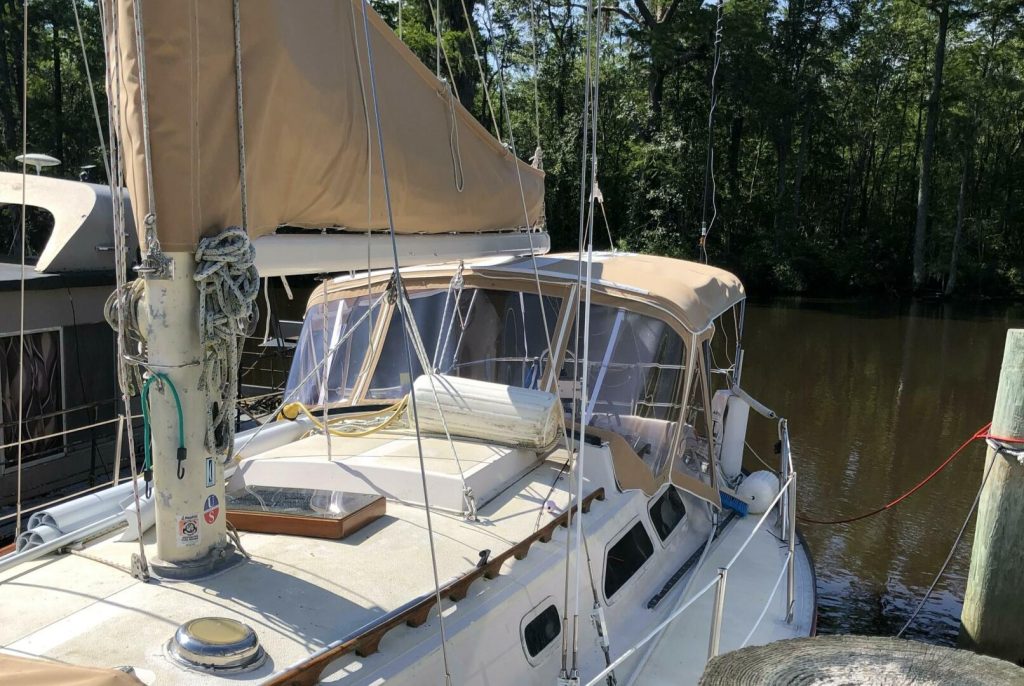
The dodger and sail cradle are new, as is the Precision cruising mainsail stowed in it. Lewmar 48 three-speed primaries handle the sheets in a cockpit that is genuinely spacious, with decent cushions and a couple of comfortable chairs. Safety gear includes a Lifesling and a boarding ladder, propane is mounted outboard on the rail, and the engine gauges are in good order. Navigation is covered by a Garmin 7-inch GPS plotter bought in 2021 or 2022, a Ritchie compass and a Garmin GPSMAP 60. The older autopilot does not work and needs repair or replacement — worth factoring into an offer. The boat is currently air conditioned by a window unit in the companionway, with separate doors made for when it isn’t in use.
Below decks
The interior reads light and spacious, helped by new teak laminate flooring and newly made hatchboards. To port is a good-sized settee alongside part of the galley, including a portable refrigerator/freezer fitted where the chart table once lived — a trade most modern navigators will happily make. The galley to starboard has a single-basin sink, a good cutting board and a two-burner Dometic gas range.
The starboard settee converts to a berth with additional cushioning. Hatches have been rebuilt to a high standard, the keel bolts were replaced at some point, and the interior woodwork — repairs and all — has clearly been kept up. Engine spares, belts, hoses and filters are stowed aboard, with two fire extinguishers installed. The head to port has a Raritan manual head, a single-basin sink and tidy joinery; the shower works but drains to the bilge, so periodic pumping and cleaning is part of the routine. Forward, the V-berth sleeps two comfortably with storage beneath and around it.
The mast is keel stepped, and when the rigging (roughly five or six years old) was replaced, the keel step was redone with a new aluminum plate. Removing the companionway steps reveals a tidy engine installation: near-new isolators, clamps and hoses in good shape, AGM house batteries under rubber flaps, and a stainless steel fuel tank aft of the engine. Crucially, Bergstrom says all of this is documented, with a stack of paperwork available for review.
Market snapshot
| Active Islander 36 listings | 1 |
|---|---|
| Asking range | $29,500 – $29,500 |
| Median asking | $29,500 |
| Inquiries, last 30 days | 0 (vs 1 prior 30) |
With few of these boats on the market at any one time, a well-documented example with new sails, new canvas and recent rigging is worth a look for a short-handed cruiser or a club racer who wants to be sailing this season.