
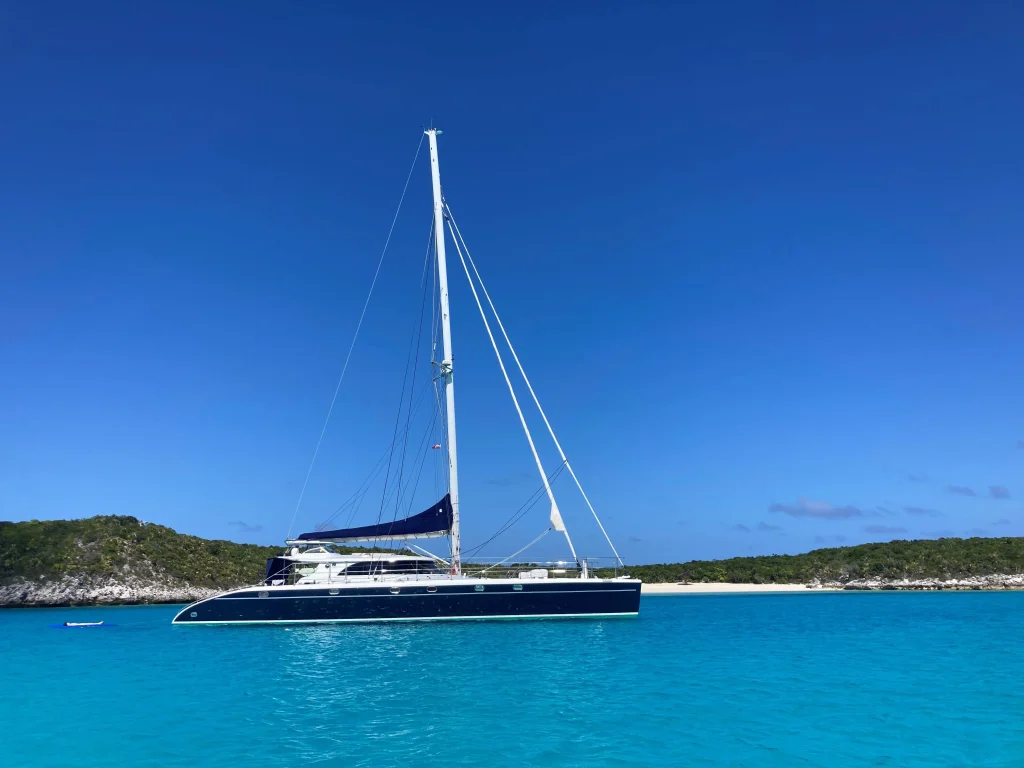
Carbon crossbeams, a hidden captive halyard winch and a transom-wide tender lift — this Australian-built catamaran was engineered for couples who want to cross oceans without a crew.

Some big catamarans are floating condominiums that happen to have masts. Others are genuine offshore machines that just happen to be comfortable. Walking the decks of Sovereign, a 2006 Lidgard 73 Executive, with broker Staley Weidman of The Catamaran Company, it’s clear which camp this one falls into. Filmed over two days in Gloucester, Virginia — including a sail on the Chesapeake Bay — the tour spends far less time on soft furnishings than on the systems that let two people handle 73 feet of Australian-built carbon and epoxy.
Rig and deck: short-handing a big boat
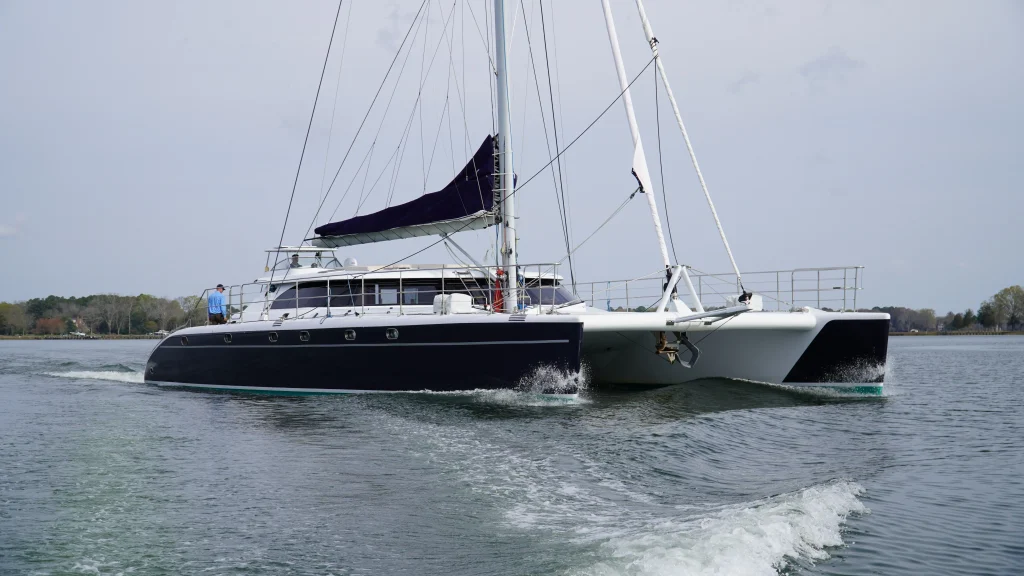
The walkthrough opens looking up at what Weidman describes as a nearly 100-foot carbon-fiber mast, with fittings that appear to be in great shape, and an aluminum boom fitted with a Park Avenue–style shelf to collect the mainsail. The lazy jacks are neatly organized and the stack pack is new. Solar panels on the coach roof feed the boat’s 12- and 24-volt systems underway.
Forward, the detail that tells you the most about the build: there’s no aluminum crossbeam. It’s all carbon and glass. Two electric furling systems are fitted (one, Weidman believes, hydraulic with an electric power pack), with life rafts mounted on deck and two anchor windlasses forward that can be actuated from the raised helm or the inside helm. A self-tacking track for the jib means you can tack through the wind without touching a sheet — a meaningful thing on a boat with a sail plan this size.
Another Australian-build signature: full-height solid stainless steel railing all the way around, rather than the usual three strands of wire. Weidman calls it real peace of mind offshore and a genuine safety feature with small children aboard. The non-skid, he notes, is in perfect condition, and the saloon glass shows no cracks or delamination.
The captive halyard winch — the party trick
The standout system aboard is one most buyers will never have seen on a sailing catamaran. The main halyard runs from the head of the sail, down through a turning block behind the anchor windlass, below deck and into a hydraulic captive winch — a spool with a level-wind device that lays the halyard neatly onto the drum. To raise or lower the mainsail you press up or down. Nothing to tail, no halyard spilling across the deck, no 2:1 block at the masthead.
Weidman takes the time to open both lockers and show the hardware: the plate, the drum, the level-wind mechanism, the splice where the cover transitions to Spectra, and the hydraulic motor on the opposite side. His point is practical. On any big cat, if you’re not dead into the wind, mainsail battens can snag in the lazy jacks — and on a conventional electric winch that means taking the line off and re-setting it. Here you simply ease the button and try again.
The rest of the hardware is in the same vein: Ronstan gear on the carbon crossbeam, a Profurl electric furling drum for the Code Zero operated by a small wireless remote (so you can furl from the sheet winch or anywhere you can keep eyes on the sail), and a curved Harken traveler shaped to the transom with a large car and an electric flat winder, actuated from the same button cluster on the starboard side as the electric mainsheet winch.
Transom, tender lift and living space
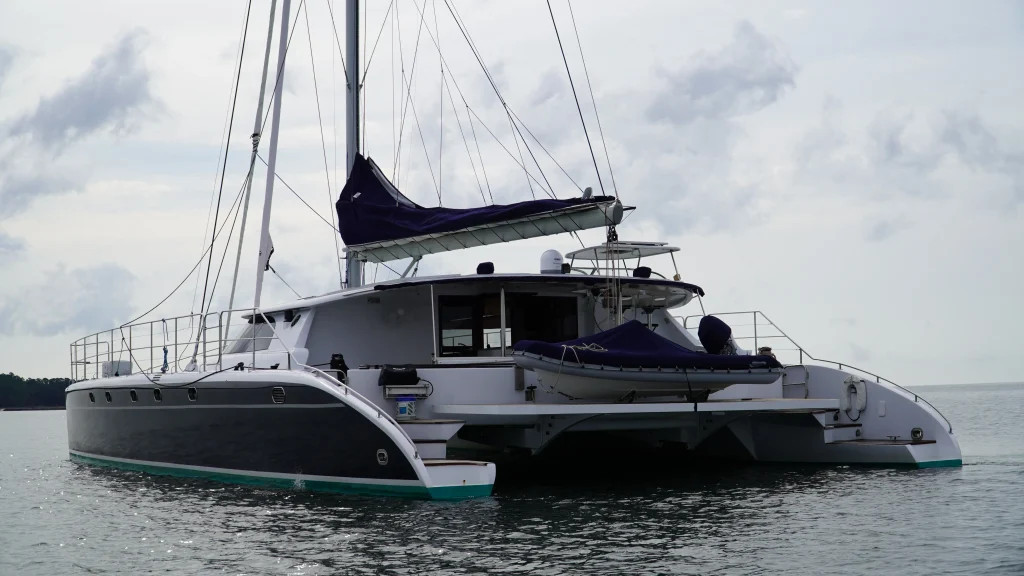
The hydraulic tender lift wasn’t original equipment — it was fitted aftermarket by the current owner — but it’s beautifully done and spans the full transom profile. It currently carries a 16-foot aluminum-hulled RIB with a center console and 50-horsepower outboard, and Weidman reckons the platform (he believes rated around 1,200 kg) could take a 19-footer on length. Operated by wireless remote, it drops straight into the water for launching the dinghy, kitting up for a dive, or setting out chairs for happy hour. He calls it one of the most desirable options on any new yacht the company sells.
The extended transoms add waterline, and with narrow appendages aft, Weidman expects that helps offshore performance — the owner reports sailing the boat at over 20 knots. Shore power connections are fitted on both sides, useful given a beam he estimates around 26 to 27 feet, along with a swim ladder, shower handle, storage for snorkel gear and a stainless shelf housing a barbecue grill with its propane bottle behind.
In the aft cockpit, teak decking is in excellent shape, a double-sided refrigerator serves both cockpit and galley, and hatches between the bar area and outside keep air moving. Removable sunscreens diffuse afternoon light at anchor.
Helm and engine rooms
The raised helm sits above the coach roof with a real windshield and full enclosure, two comfortable seats, panoramic visibility and a clear overhead view of the mainsail and mast. Instrumentation is newly installed Garmin: chart plotter, radar, AIS, wind instruments, plus a wireless autopilot remote and VHF. Also at hand are electronic engine throttles, controls for both electric anchor windlasses, hydraulic daggerboard raise/lower, underwater lights and the bow thruster. A night sequence in the video shows the whole package lit and operational. For genuinely foul weather, there’s a second helm station inside.
The port engine compartment has a larger above-deck entrance because it houses the washer and dryer, two freezer compartments, a water maker and the tender lift hydraulic control — with the Yanmar engine below in a soundproof containment box that keeps the space cooler and quieter. The detail Weidman singles out as proof of the build quality is the stainless steel bilge pump manifold with high-quality valves, alongside the stainless pipework for fuel fill and transfer and a fire suppression system. In the starboard engine room he measures roughly 8 feet of standing headroom above the engine — it looks tight on camera, he says, but there’s plenty of room to work.
Forward, the port bow locker holds line hangers, one of the boat’s two bow thrusters (easily accessed, and working perfectly during the Chesapeake sail), and generous stowage for spare sails and lines, reached by a ladder with wide flat rungs.
Where she sits in the market
The Lidgard 73 Executive is a rare bird, and the current market reflects that.
| Active Lidgard 73 Executive listings | 1 |
|---|---|
| Asking price | $1,995,000 |
| Median asking | $1,995,000 |
For a buyer weighing a long-distance, short-handed program — the kind where you’d rather push a button than wrestle a halyard at 3 a.m. — Sovereign makes a persuasive case on camera.