
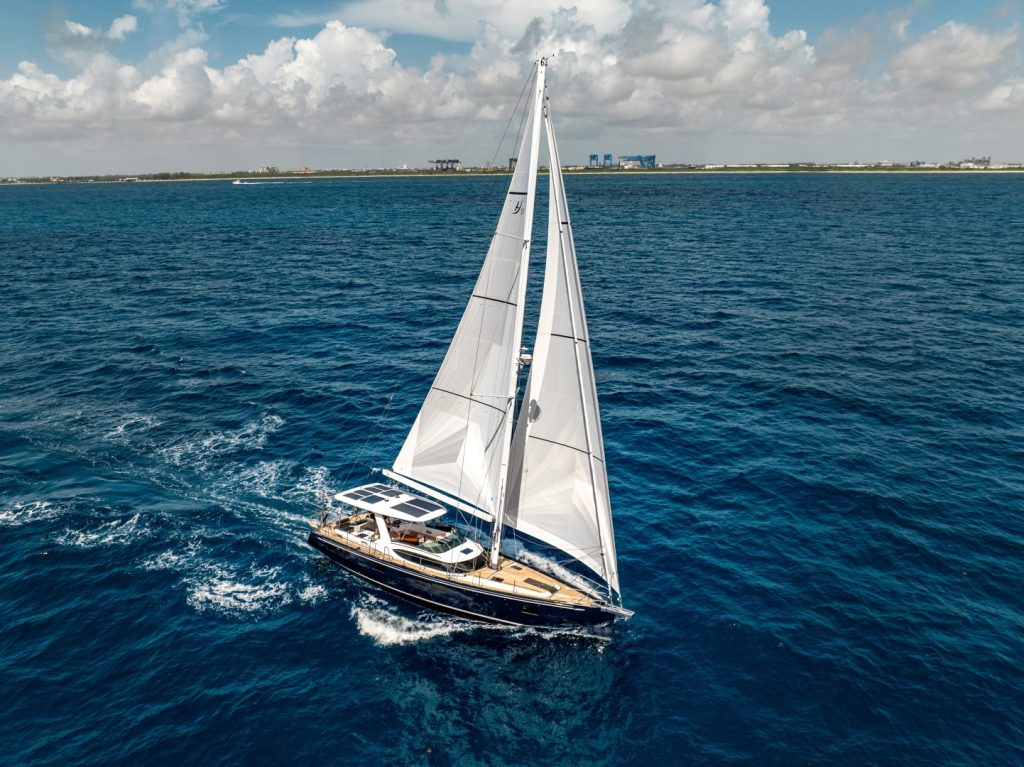
Kevin Wensley walks the flag-blue H57 stem to stern — twin helms, in-mast furling, collision bulkheads fore and aft, and a master suite that uses nearly the full beam.

Some walkthroughs skim the surface. This one doesn’t. Kevin Wensley, national sales manager for Hylas Yachts in the United States, spends his time aboard the Hylas H57 explaining why things are the way they are — from laminate schedules to why the halyard tails get detached at the mast. For a buyer weighing a serious bluewater boat, that’s the useful kind of tour.
Built for the long haul
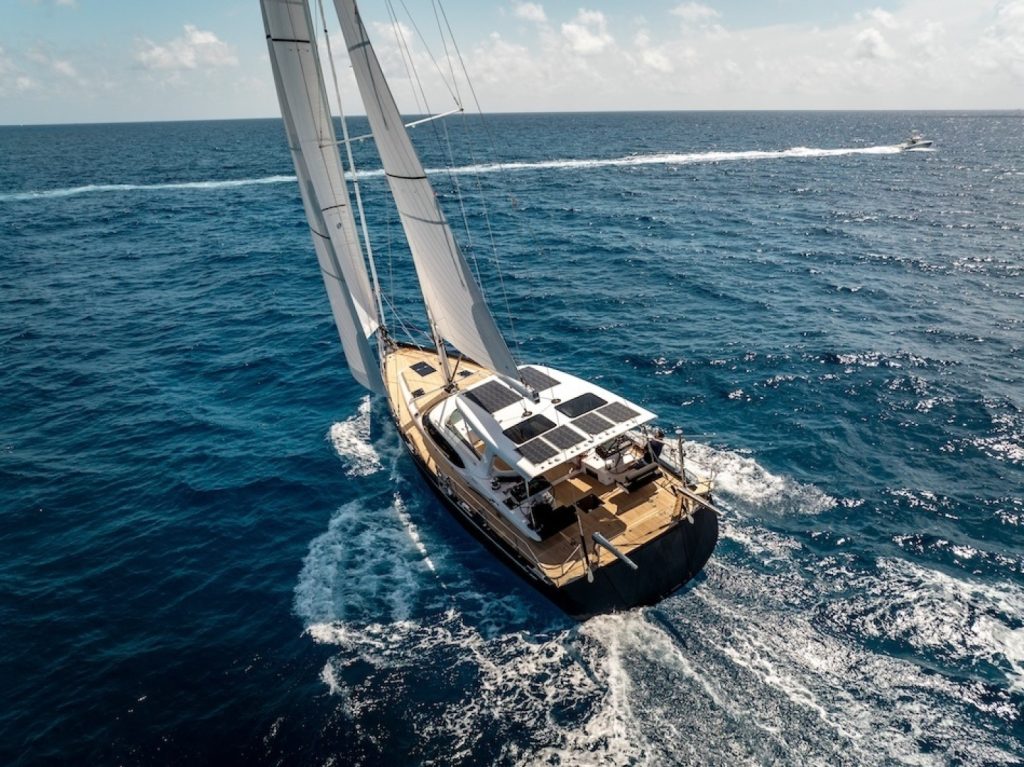
The flag-blue hull is fiberglass laminate with closed-cell foam, vacuum infused — a process Wensley says yields a structure 40% stronger and 8% lighter than traditional hand layup. Carbon elements are added where loads concentrate, such as the arch supporting the hardtop. Below the waterline there are five coats of epoxy barrier coat. Up top, the hardtop carries 1,100 watts of solar.
Two details stood out as evidence of genuine offshore thinking. The forward anchor/sail locker — cavernous enough, Wensley jokes, that he’s slept in smaller rooms — is closed off aft by a structural watertight collision bulkhead. The same arrangement exists at the stern, forward of the rudder posts. Hit something hard, or back into something hard, and water stays out of the main body of the yacht.
Twin helms, aft and elevated
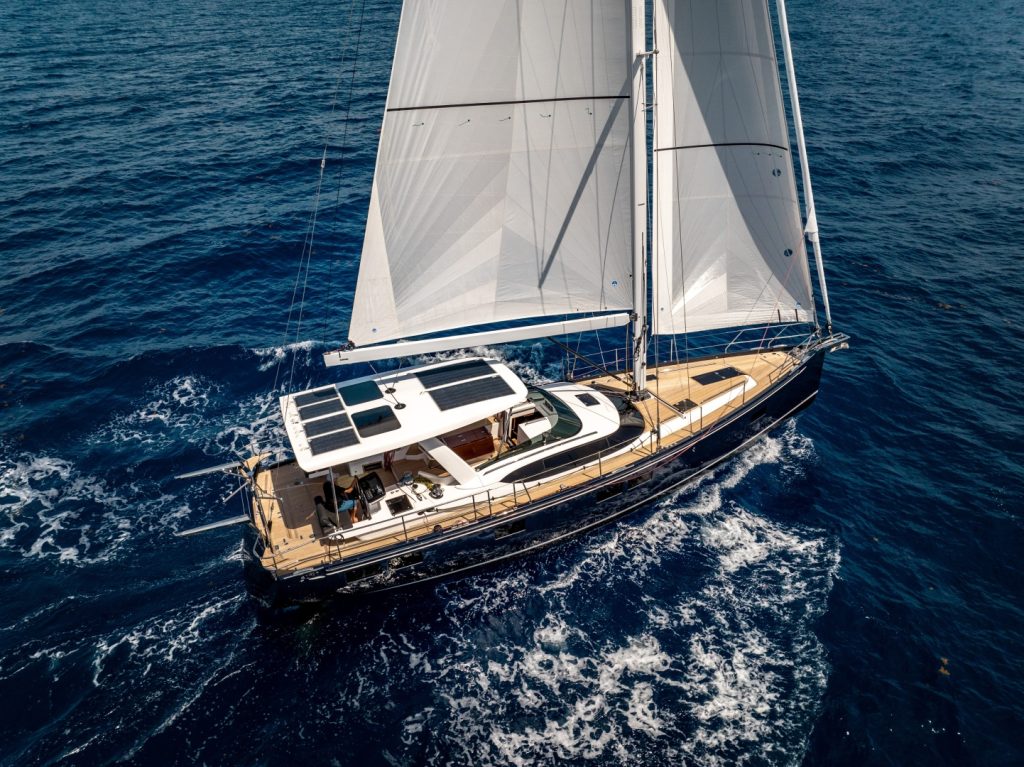
Technically still a center-cockpit design, the H57 moves the helm stations aft and up. Every control is duplicated at both wheels: engine controls, thruster controls, chart plotter, autopilot. Whichever side is closest to the dock, that’s where you can stand with full command of the boat. Bow and stern thrusters are both variable speed, which Wensley frames squarely at the buyer who gets tense in tight marinas.
Each winch has three activation points — one at each helm plus the traditional on-deck buttons — a shorthanded-sailing feature that matters more than it sounds. The hardtop extends past the helm seats and can be fully enclosed for shoulder seasons, with large skylights over each helm for sail trim. Wensley notes that many owners add cameras streaming live to the chart plotter for extra visibility aloft.
Forward of the wheels is what he calls the purely social cockpit: teak table with a center cooler, a spray shield forward, and the option to enclose the whole space. Lines running aft from the mast disappear under a teak grate. A life rail rather than lifelines pushes the usable cockpit width out to the raised bulwark, which is lit to illuminate the side decks at night — a small, thoughtful touch. Pop-up Sea Smart cleats sit on the toe rail; the swim platform has pop-up cleats of its own and a stainless striker plate to fend off dinghy damage.
Sail plan
The rig is Selden, with in-mast furling — the yard’s recommendation. North Sails supplies the wardrobe, upgraded from Dacron to NPL Tour, a synthetic that holds shape over years and furls cleanly. Everything furls: a self-tacking blade inside, a 130% reacher outside, and a bow fitting ready for a Code sail or asymmetric. Because sails roll in and out rather than going up and down, halyard tails can be stowed on mast tracks, keeping the foredeck sightline clear.
Below decks
The design brief, Wensley says, was to avoid the cave feeling. Three-dimensional strengthened glass windows and oversized port lights, combined with a raised sole, mean you see the seascape sitting or standing. That raised sole also buys volume for water tanks, fuel and batteries — low and centered over the keel.
To port is a seated, forward-facing nav station with the classic Hylas tactile electrical panel, plus Raymarine integration that lets you run the whole boat from below. Engine access is right there: a Volvo Penta D3 rated 150 horsepower, a Northern Lights 12kW generator above it, dual Racor filtration that can polish fuel without running the engine, a Bruntons variable prop and a PSS dripless shaft seal.
The galley is generous — ice maker, microwave, drinks cooler, LPG cooker, a full-size refrigerator with two freezer compartments, and, unusually for a sailing yacht, a dishwasher. Aft, the master stateroom uses nearly the full beam (17 feet at midships, roughly 15.5 feet here) for a full-size queen with access both sides, pad eyes fitted for lee cloths, and an ensuite with separate shower stall that doubles as secondary engine access.
Forward to starboard, this particular boat is configured with a bunk-plus-utility space: washer/dryer and tool storage beneath, and a stainless plate under the mattress so it works as a bench. The VIP forward is, in Wensley’s words, rather too splendid — natural light, hanging lockers both sides, and the reverse-osmosis watermaker tucked beneath the berth with filters remotely plumbed for easy servicing.
Where the H57 sits
The Hylas 57 is a thinly traded boat, which is worth knowing going in.
| Metric | Figure |
|---|---|
| Solds, last 24 months | 1 |
| Median sold price | $2,500,000 |
| Median days to sell | ~101 |
| Active listings | 2 |
| Asking range | $1,895,000–$2,915,000 |
Wensley closes by noting that show models are available in California and Florida for test sails and private showings. For anyone shortlisting a 57-foot offshore cruiser, this listing — S/V H57-10, offered by Ted Reshetiloff — is worth a call.