
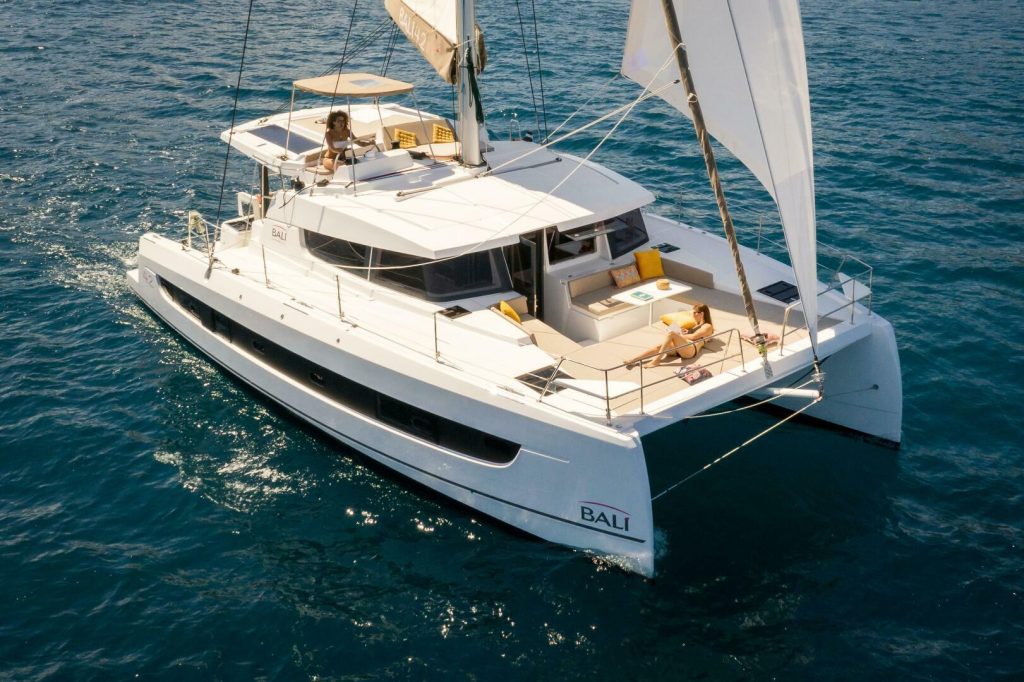
Two years of teaching aboard a Bali 4.2 produced some candid advice — reef early, sheet the jib tight, and never close the garage door.

Most catamaran walkthroughs are a parade of features. This one is different. The Bali 4.2 in this video spent two years as a sailing school boat, and the instructor who logged those miles — Steele Greyling — talks through what actually worked on the water: when to reef, how to get the bows through the eye of the wind, how the Code Zero behaves, and where the cold beer lives. For anyone weighing a Bali 4.2, it is an unusually useful half hour.
Sailing a small forward triangle
The first topic raised is the one that dominates every Bali conversation: performance. The 4.2 carries a self-tacking jib on a small forward triangle, and the instructor’s solution in Florida’s light summer air is counterintuitive. He sailed with the first reef in the main more than 90% of the time — even in eight knots of breeze. The logic: with the full main up and no large headsail to balance it, the boat tries to round up, leaving you holding 12 to 15 degrees of rudder angle and scrubbing off speed. Reef the main, keep it filled, carry the boom high so it spills a little air, and the boat moves better. Once the breeze builds to around 12 knots, he says, the jib is big enough to counter the main and the usual rules apply again.
Does it keep up? He raced whatever looked fast, and reports out-sailing roughly 80% of same-size monohulls — a result that surprised nearly every student who stepped aboard convinced a monohull must be quicker. Against similar-size catamarans of other brands, he calls it close and largely down to who trims better.
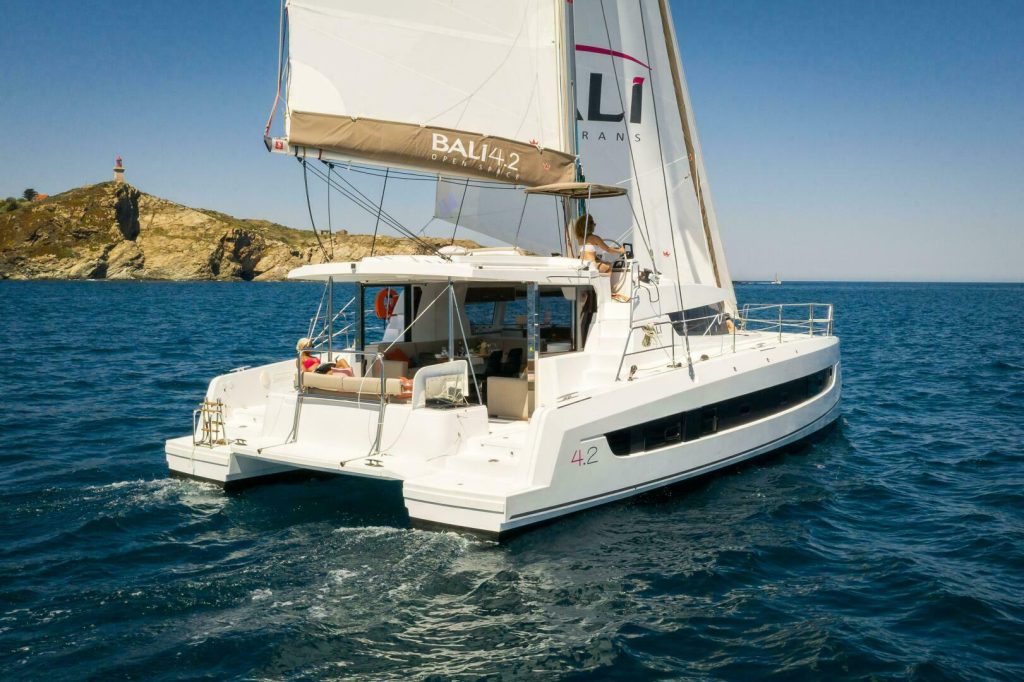
Tacking a small self-tacking jib takes technique, and he shares his: sheet the jib in tight before the tack so it doesn’t catch wind early and push the bow back downwind, ease the mainsheet so a tight main can’t fight the turn, then put the wheel hard over and leave it there until the bow has passed 60 degrees on the new side. Under engine, he says, maneuvering is simply easy.
The Code Zero gets a warm review. Because the 4.2’s rig has no spreaders, there is nothing for the sail to foul on, so it can be sheeted hard — he has carried it as high as 60 degrees apparent upwind, and uses it through to 180. He keeps a personal ceiling of about 18 knots apparent, noting it is a lot of sail area for a boat this size. The top speed question gets a straight answer: 13.5 knots under Code Zero on a beam swell during a northerly passage from Florida toward Bermuda. The wind speed, he jokes, stays a secret.
Deck layout: the Bali signatures
The tour starts on the foredeck. Code Zero sheets are stowed at the bow out of the walking path; the furling line runs aft to the cockpit, and the tack line is held by a clutch that can be worked inboard rather than from out on the sprit. The self-tacking jib furler leads back to the same place. The bow rail is close to waist high.
The forward cockpit, he says, is fully usable under sail and stays dry unless you are bashing into big waves; it seats six comfortably and served as his primary dining table both at anchor and underway. The solid foredeck — the feature buyers most often question — drains through two small holes at the bow plus a large drain outside the forward door and under the anchor locker hatch. Even with water coming over the bow in big seas, he never saw it pool. Anchoring without trampolines to sight through was a non-issue: the anchor locker opening gives plenty of visibility, and the windlass can be worked from the locker or from the flybridge.
The other Bali trademark, the tilting garage-style aft door, gets used daily. His rule of thumb: on the 4.2 the opening sits lower than on the 5.4, so close it in chop, but inside a bay or between close islands his back door never closed.
Side decks are wide and free of hatches or windows to stub a toe on, with a long grab rail overhead and guard rails outboard. Gently sloped steps lead to the flybridge, where every sheet, halyard and reef line terminates — one electric winch to port for halyards, manual winches to starboard and outboard port. Visibility from the helm covers both bows and one stern, and the chart plotter, autopilot control, engine panels, windlass control, compass, throttles and a tucked-away handheld VHF are all within reach. The adjacent lounge is, in his words, the best sun deck on the boat.
Engines, systems and accommodation
Power comes from twin Yanmar 4JH 45 hp diesels, which he describes as reliable and trusted; at 2,000 to 2,200 RPM he sees just under a gallon an hour per engine. The engine spaces are roomy enough to stand on both sides and work comfortably. Also aboard: a 12-volt watermaker producing about 30 gallons an hour without needing the generator, plus easily reached steering cabling, the Raymarine autopilot control and its ram.
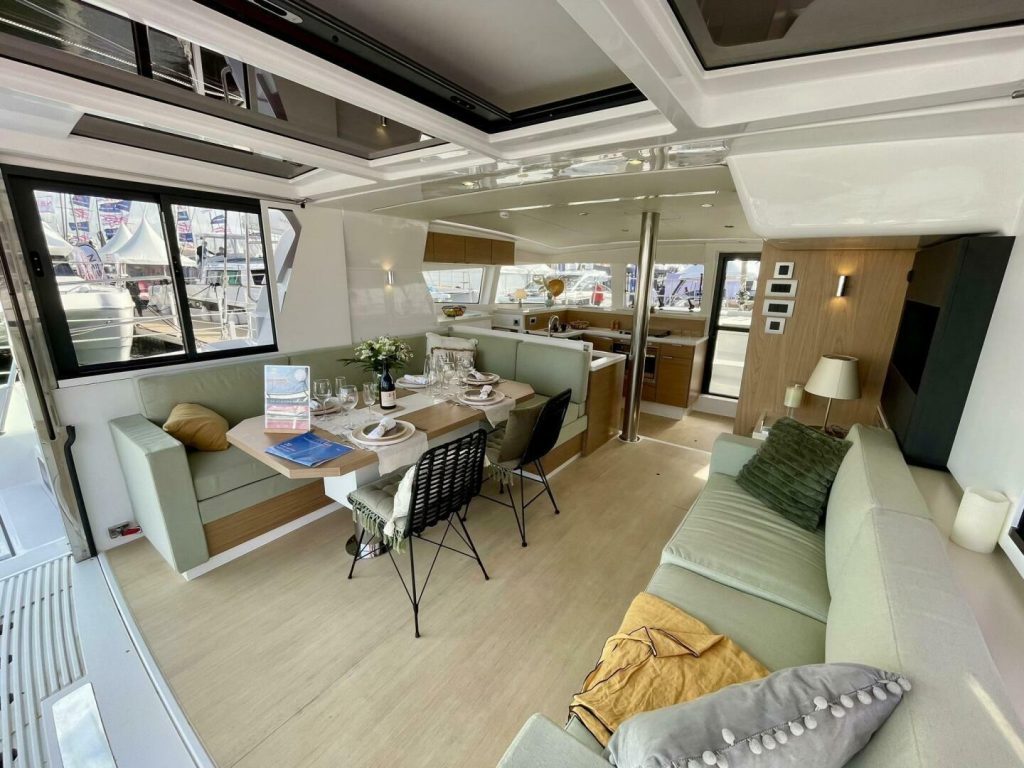
Inside, the forward galley and nav station sit alongside a door that opens straight through to the foredeck for ventilation, paired with a forward-opening window. The galley has a three-burner propane stove with oven, generous cabinetry, two pantries below and a notably large fridge-freezer that locks underway. Saloon settee cushions hide storage — his went to tools, spares and cold drinks — and the table drops on removable legs with an infill cushion to form a berth. A small captain’s hatch passes sandwiches and conversation out to the cockpit.
The layout is three cabins, three heads. The owner’s suite is semi walk-around with a seating area, desk and storage, and a head with two wash basins. In the starboard hull, both the aft and forward cabins have their own en suite heads with shower, the forward one with a queen berth.
Where the 4.2 sits in the market
For context on the model, YachtSite’s own figures show a thin but active picture.
| Metric | Figure |
|---|---|
| Bali 4.2 sold, last 24 months | 5 |
| Median sold price | $600,000 |
| Median time to sell | ~261 days |
| Active listings now | 3 |
| Asking range | $415,000 – $834,525 |
| Median asking price | $449,000 |
| Median sold (24 mo) | $600,000 | |||
| Median asking (active) | $449,000 |
What the video ultimately delivers is a picture of a 42-foot cruising catamaran that rewards a skipper who understands its rig: reef early, keep the main balanced against a modest self-tacker, and hoist the Code Zero when the angle allows. In return you get flat, wide-open living space, a dry forward cockpit that doubles as the dining room, and systems laid out for short-handed sailing.
The Bali 4.2 is listed with Eric Macklin on YachtSite.com.